Joseph Saseen, PharmD, discusses how pharmacists can overcome therapeutic inertia and sequence nonstatin therapies to help patients reach individualized LDL-C goals.

Joseph Saseen, PharmD, BCPS, BCACP, CLS, is professor and associate dean for clinical affairs in the Department of Clinical Pharmacy at the University of Colorado Anschutz Skaggs School of Pharmacy and Pharmaceutical Sciences.
Joseph Saseen, PharmD, discusses how pharmacists can overcome therapeutic inertia and sequence nonstatin therapies to help patients reach individualized LDL-C goals.
Pharmacists step into cardiovascular prevention with patient education, statin protocols, and new prescribing training—if clinical work gets paid.
Pharmacists unpack easier access to PCSK9 inhibitors and inclisiran—smart prior auth, Medicare Part B nuances, and foundation help that cuts costs.
Paste the article text (or an excerpt), and I’ll generate a 150-character, 24-word max SEO meta description in present tense.
Pharmacists drive new cholesterol care: educate patients, tackle prior auth and cost barriers, and improve adherence to statins and
Pharmacists speed cholesterol guideline adoption through patient education, prior auth support, and adherence fixes for
Learn how clinicians tailor add-on lipid therapies—PCSK9s, ezetimibe, bempedoic acid—using shared decisions, follow-up, and statin myths.
Please paste the article text (or a link/excerpt). I’ll generate an SEO-friendly meta description (≤24 words, ≤150 characters) in present tense.

Joseph Saseen, PharmD; and Joel C. Marrs, PharmD, discuss key updates in the 2026 dyslipidemia guidelines and their implications for clinical and pharmacy practice.
Learn how CAC scores, PREVENT ASCVD, and Lp(a) reshape risk talks—help pharmacists personalize statins, targets, and follow‑up.
Learn how CAC scans, PREVENT ASCVD scoring, and Lp(a) testing sharpen risk talks and guide statin choices in pharmacy practice.
Panelists examine how LDL-C targets vary by cardiovascular risk level and highlights the role of pharmacists and multidisciplinary teams in delivering effective patient education to improve adherence and long-term outcomes.
Panelists explore how treatment goals differ between primary and secondary cardiovascular prevention, emphasizing risk stratification, guideline application, and strategies to optimize long-term outcomes through individualized, multidisciplinary care.
2026 dyslipidemia guideline updates highlight earlier risk-based lipid management, expanded biomarker use, and a growing pharmacist role in cardiovascular prevention.
Joseph Saseen, PharmD, addresses statin intolerance and misinformation and provides a look at aggressive new LDL targets and emerging therapies not yet captured in the 2026 guidelines.
Pharmacists' role in lipid management takes center stage with the 2026 dyslipidemia guideline update.
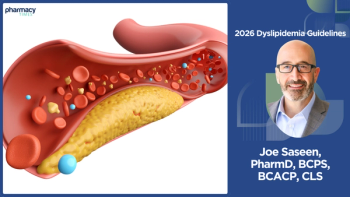
Joseph Saseen, PharmD, explains the 2026 dyslipidemia guidelines' push for universal lipoprotein A screening, clarifies when apolipoprotein B testing adds value, and outlines how new FDA-approved therapies fit into the updated lipid-lowering treatment algorithm.
Joseph Saseen, PharmD, breaks down how the new PREVENT ASCVD calculator improves on its predecessor and what the expanded LDL-C goal framework means for treatment decisions in pharmacy practice.
Joseph Saseen, PharmD, explains how population health strategies and team-based care create new opportunities for pharmacists to identify lipid treatment gaps and lead evidence-based ASCVD prevention.
Joseph Saseen, PharmD, highlights how pharmacists can close treatment gaps in dyslipidemia by initiating appropriate statin intensity early, using combination therapy when needed, and proactively assessing adherence.

The VESALIUS-CV trial demonstrates that adding evolocumab to maximally tolerated statin therapy significantly reduces major cardiovascular events in both high-risk primary and secondary prevention patients.
Joseph Saseen, PharmD, explains how persistent cholesterol myths undermine care and why emerging oral proprotein convertase subtilisin/kexin type 9 (PCSK9) inhibitors could expand access to intensive LDL-C lowering.
The panel concludes its discussion with insights on successful strategies that can inform optimal collaborative care practices for cardiovascular risk reduction in patients with ASCVD.
Clinical insights on how real-world treatment persistence and discontinuation rates compare between the various non-statin therapies and the factors that contribute to these differences.
The expert panel discusses the cost-effectiveness and clinical evidence gaps for non-statin therapies, including PCSK9 inhibitors, inclisiran, and bempedoic acid.
Focusing on PCSK9 inhibitors, inclisiran, and bempedoic acid, the panel compares treatment efficacy and outlines patient factors that influence treatment decisions.
Turning the focus to non-statin therapies, the panel outlines logistical barriers and discusses the characteristics that guide treatment selection in patients with ASCVD.
Clinical pharmacists discuss how to address key barriers that get in the way of implementing guideline-directed cholesterol treatment.
The panel compares the ACC/AHA cholesterol guidelines with the ESC/EAS guidelines and provides thoughts on how educational initiatives can be improved to increase familiarity and implementation.
Examination of pharmacy behaviors before and after implementation indicated that restrictions in pharmacy benefits may not deter utilization for Part D.
February 17th 2026
February 14th 2026