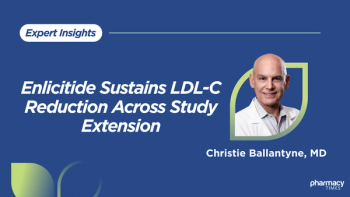
Christie Ballantyne, MD, explains how the CORALreef Extension study adds safety exposure and shows LDL-C lowering with oral enlicitide is sustained over time.
Christie Ballantyne, MD, says high extension enrollment and a single 20-mg daily dose are encouraging signs for patient adherence to oral enlicitide.
In an interview with Pharmacy Times, Christie Ballantyne, MD, chief of cardiology and cardiovascular research and director of cardiometabolic disease prevention at Baylor College of Medicine, discussed tolerability and adherence considerations for enlicitide (Lipfendra; Merck), an oral proprotein convertase subtilisin/kexin-type 9 (PCSK9) inhibitor, from the open-label CORALreef Extension (NCT06492291) study presented at the
Ballantyne noted that the 87% of participants who chose to enroll in the study is an encouraging metric for adherence, noting that participants wanted to keep receiving the drug as the extension ended. He described enlicitide as easy to use, with a single 20-mg dose and discontinuations due to adverse events numerically lower than with placebo. The main hassle factor is morning fasting administration. He said pharmacists can support long-term adherence through refill reminders and feedback on lipid results, particularly for asymptomatic conditions such as hyperlipidemia and hypertension.
Pharmacy Times: What did the high rate of participants choosing to enroll in the extension tell you about tolerability?
Christie Ballantyne, MD: That’s a very important question, Luke. The fact that 87% of people wanted to continue with this is something that is really encouraging about what we’ll see for patient adherence. One of the things about having a pill is it’s easy to take. I think primary care physicians and health care providers are used to prescribing a pill. Patients are used to taking a pill, and it was very nice to see this. In fact, right now, as the extension is ending, what we’re seeing is the patients want to stay in it as long as possible to keep getting the medication. Now that it’s been approved since July, people are rolling over to getting it at the pharmacy. It has been really encouraging: not only the efficacy, but also the kind of ease.
This is a drug that I would say is an easy drug to use. For the provider, there’s only 1 dose, so it’s not too hard to remember: 20 milligrams. And then for the patient, if you looked at the overall studies in terms of discontinuations due to adverse events, it was actually numerically lower in the treated patients than the placebo patients. So it’s a well-tolerated medication. I mean, the only possible hassle factor is you have to take it in the morning, fasting. Although this is very common, for example, thyroid is one of the most common medications that people take. My wife takes thyroid supplementation, and she gets up in the morning and she takes her thyroid medication. You can take this medication with other medications, so that’s not a problem. You can drink it with water. You can have it with coffee. We found that it’s just been easy for administration, easy for the health care provider, and easy for the patient.
Pharmacy Times: How might a once-daily oral PCSK9 inhibitor change how pharmacists counsel patients on adherence?
Ballantyne: I think pharmacists in general have gotten better in terms of getting messages out, as in, “Your prescription is up. It’s time to get a renewal.” It’s the same kind of a thing in general for both hypertension and hyperlipidemia. It is really important to make sure that patients are staying on therapy. It would be nice if people could get their lipids checked in the pharmacy, and some pharmacies are doing that. But giving people the feedback that, “You’re getting a good result; you need to keep taking the medication,” is very important for long-term adherence when you’re dealing with asymptomatic conditions. That’s the same thing for hypertension and hyperlipidemia. The nice thing is that you can usually get by now with pretty simple combinations for very effective control of both lipids and blood pressure. And it’s actually, I think, now gotten to be even easier for lipids than it is for blood pressure.